
Modern Construction-
The modern era of lighthouses began at the turn of the 18th century, as lighthouse construction boomed in lockstep with burgeoning levels of transatlantic commerce. Advances in structural engineering and new and efficient lighting equipment allowed for the creation of larger and more powerful lighthouses, including ones exposed to the sea. The function of lighthouses shifted toward the provision of a visible warning against shipping hazards, such as rocks or reefs. The Eddystone Rocks were a major shipwreck hazard for mariners sailing through the English Channel. The first lighthouse built there was an octagonal wooden structure, anchored by 12 iron stanchions secured in the rock, and was built by Henry Winstanley from 1696 to 1698. His lighthouse was the first tower in the world to have been fully exposed to the open sea.
The civil engineer, John Smeaton, rebuilt the lighthouse from 1756–59; his tower marked a major step forward in the design of lighthouses and remained in use until 1877. He modelled the shape of his lighthouse on that of an oak tree, using granite blocks. He pioneered the use of "hydraulic lime," a form of concrete that will set under water, and developed a technique of securing the granite blocks together using dovetail joints and marble dowels. The dovetailing feature served to improve the structural stability, although Smeaton also had to taper the thickness of the tower towards the top, for which he curved the tower inwards on a gentle gradient. This profile had the added advantage of allowing some of the energy of the waves to dissipate on impact with the walls. His lighthouse was the prototype for the modern lighthouse and influenced all subsequent engineers.
One such influence was Robert Stevenson, himself a seminal figure in the development of lighthouse design and construction. His greatest achievement was the construction of the Bell Rock Lighthouse in 1810, one of the most impressive feats of engineering of the age. This structure was based upon Smeaton's design, but with several improved features, such as the incorporation of rotating lights, alternating between red and white. Stevenson worked for the Northern Lighthouse Board for nearly fifty years during which time he designed and oversaw the construction and later improvement of numerous lighthouses. He innovated in the choice of light sources, mountings, reflector design, the use of Fresnel lenses, and in rotation and shuttering systems providing lighthouses with individual signatures allowing them to be identified by seafarers. He also invented the movable jib and the balance crane as a necessary part for lighthouse construction.
Alexander Mitchell designed the first screw-pile lighthouse – his lighthouse was built on piles that were screwed into the sandy or muddy seabed. Construction of his design began in 1838 at the mouth of the Thames and was known as the Maplin Sands lighthouse, and first lit in 1841. Although its construction began later, the Wyre Light in Fleetwood, Lancashire, was the first to be lit (in 1840).
Lighting improvements-
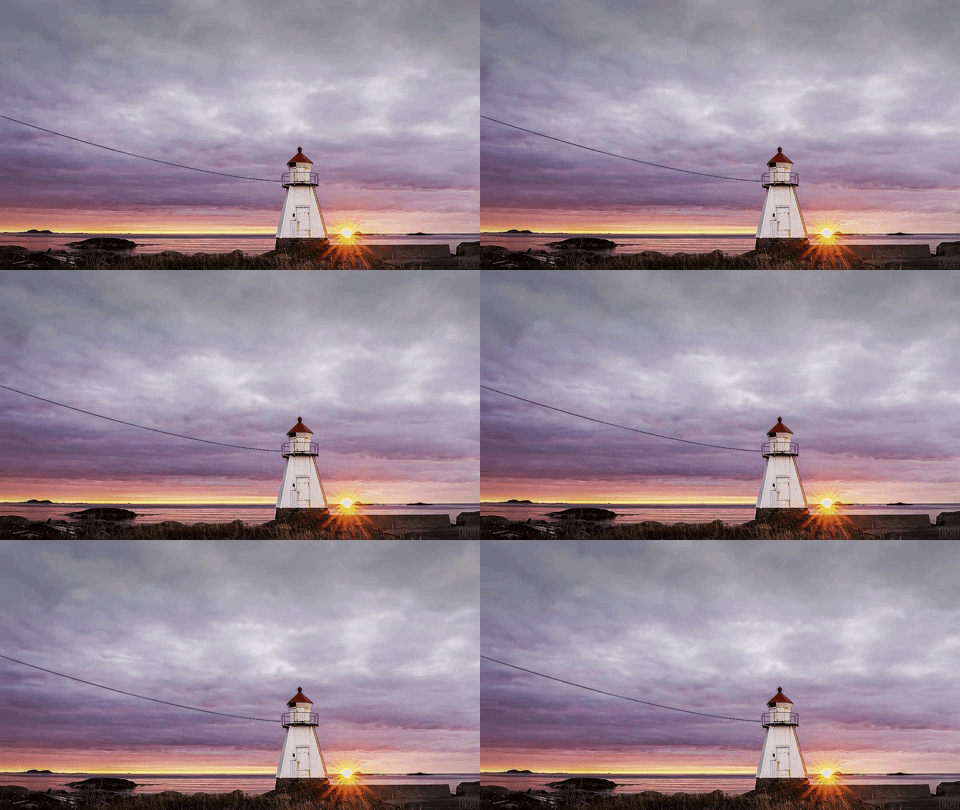
The source of illumination had generally been wood pyres or burning coal. The Argand lamp, invented in 1782 by the Swiss scientist, Aimé Argand, revolutionized lighthouse illumination with its steady smokeless flame. Early models used ground glass which was sometimes tinted around the wick. Later models used a mantle of thorium dioxide suspended over the flame, creating a bright, steady light. The Argand lamp used whale oil, colza, olive oil[10] or othervegetable oil as fuel which was supplied by a gravity feed from a reservoir mounted above the burner. The lamp was first produced by Matthew Boulton, in partnership with Argand, in 1784 and became the standard for lighthouses for over a century.
South Foreland Lighthouse was the first tower to successfully use an electric light in 1875. The lighthouse's carbon arc lamps were powered by a steam-driven magneto. John Richardson Wigham was the first to develop a system for gas illumination of lighthouses. His improved gas 'crocus' burner at the Baily Lighthouse near Dublin was 13 times more powerful than the most brilliant light then known.
The vaporized oil burner was invented in 1901 by Arthur Kitson, and improved by David Hood atTrinity House. The fuel was vaporized at high pressure and burned to heat the mantle, giving an output of over six times the luminosity of traditional oil lights. The use of gas as iluminant became widely available with the invention of the Dalén light by Swedish engineer, Gustaf Dalén. He used Agamassan (Aga), a substrate, to absorb the gas allowing safe storage and hence commercial exploitation. Dalén also invented the 'sun valve', which automatically regulated the light and turned it off during the daytime. The technology was the predominant form of light source in lighthouses from the 1900s through the 1960s, when electric lighting had become dominant.
Optical systems-
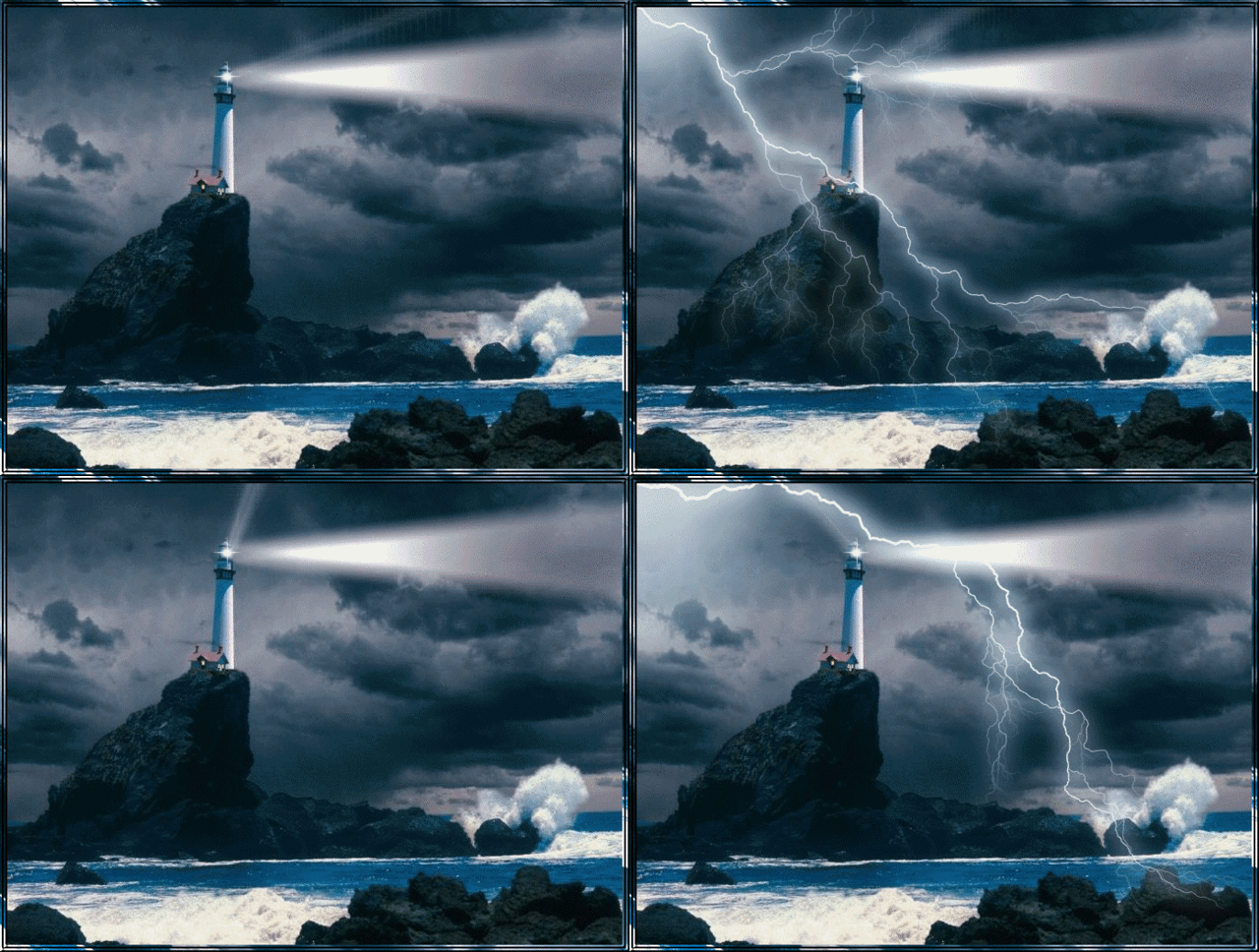
With the development of the steady illumination of the Argand lamp, the application of optical lenses to increase and focus the light intensity became a practical possibility. William Hutchinson developed the first practical optical system in 1763, known as a catoptric system. This rudimentary system effectively collimated the emitted light into a concentrated beam, thereby greatly increasing the light's visibility. The ability to focus the light led to the first revolving lighthouse beams, where the light would appear to the mariners as a series of intermittent flashes. It also became possible to transmit complex signals using the light flashes.
French physicist and engineer Augustin-Jean Fresnel developed the multi-partFresnel lens for use in lighthouses. His design allowed for the construction of lenses of large aperture and short focal length, without the mass and volume of material that would be required by a lens of conventional design. A Fresnel lens can be made much thinner than a comparable conventional lens, in some cases taking the form of a flat sheet. A Fresnel lens can also capture more oblique light from a light source, thus allowing the light from a lighthouse equipped with one, to be visible over greater distances.
The first Fresnel lens was used in 1823 in the Cordouan lighthouse at the mouth of the Gironde estuary; its light could be seen from more than 20 miles (32 km) out. Fresnel’s invention increased the luminosity of the lighthouse lamp by a factor of 4 and his system is still in common use.
Lighthouse Technology-
In a lighthouse, the source of light is called the "lamp" (whether electric or fueled by oil) and the concentration of the light is by the "lens" or "optic". Originally lit by open fires and later candles, the Argand hollow wick lamp and parabolic reflectorwere introduced in the late 18th century.
Whale oil was also used with wicks as the source of light. Kerosene became popular in the 1870s and electricity and carbide (acetylene gas) began replacing kerosene around the turn of the 20th century.[18] Carbide was promoted by the Dalén light which automatically lit the lamp at nightfall and extinguished it at dawn.
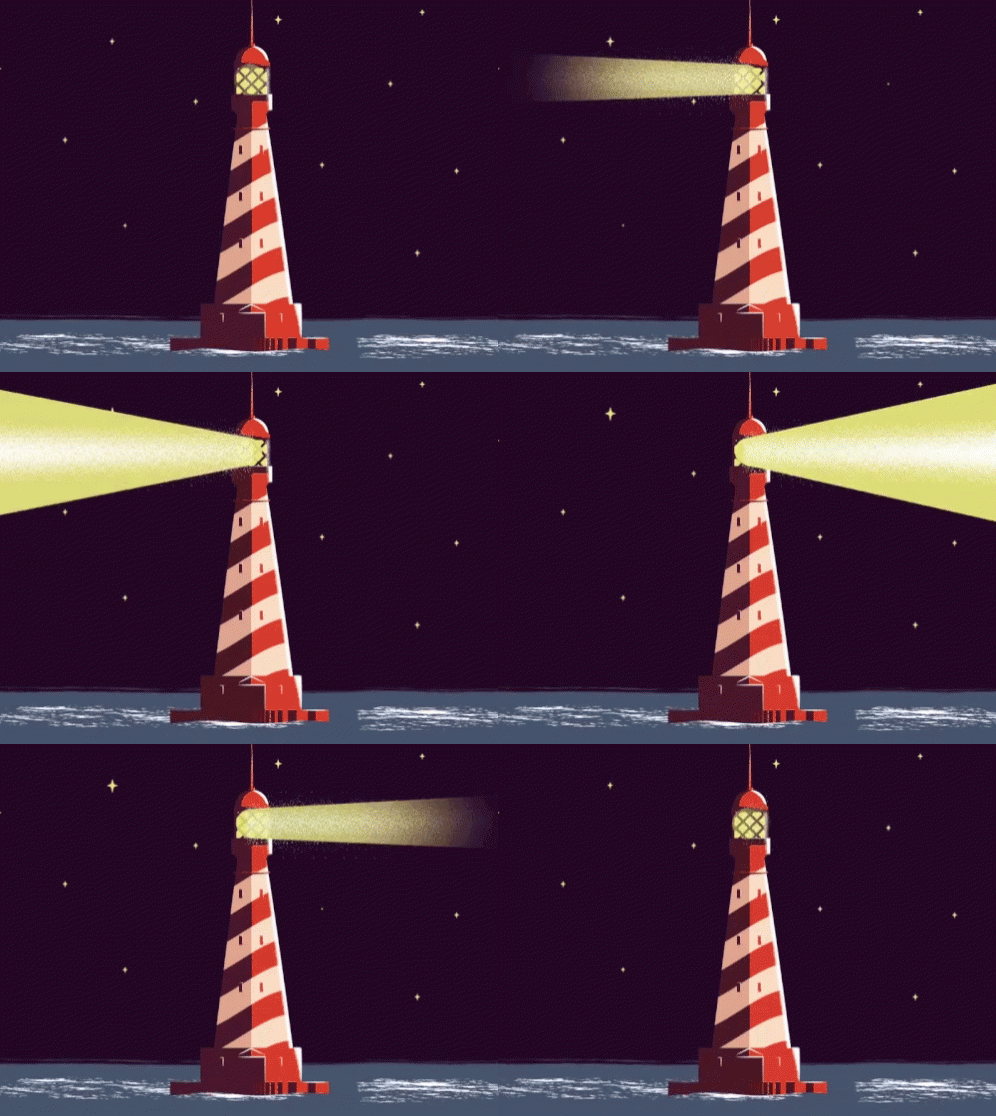
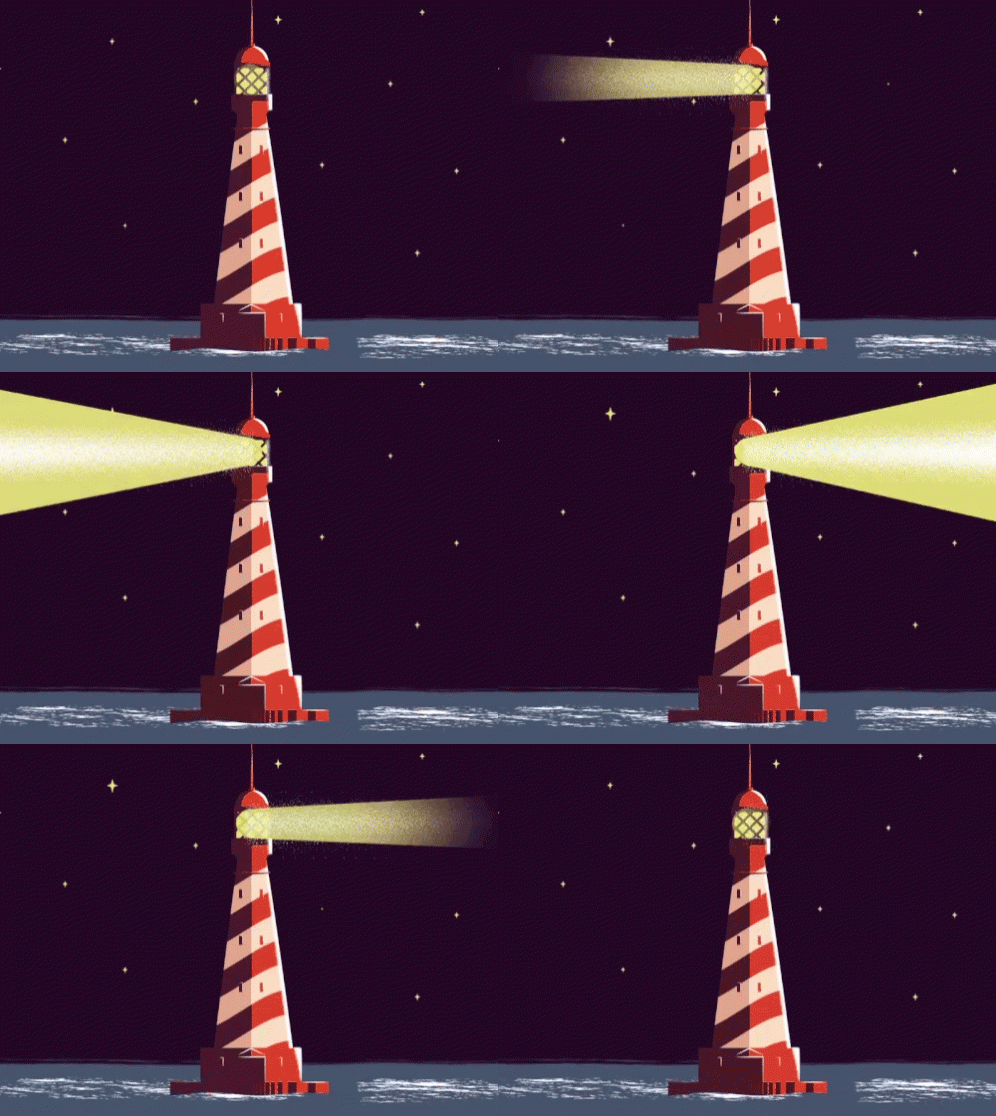
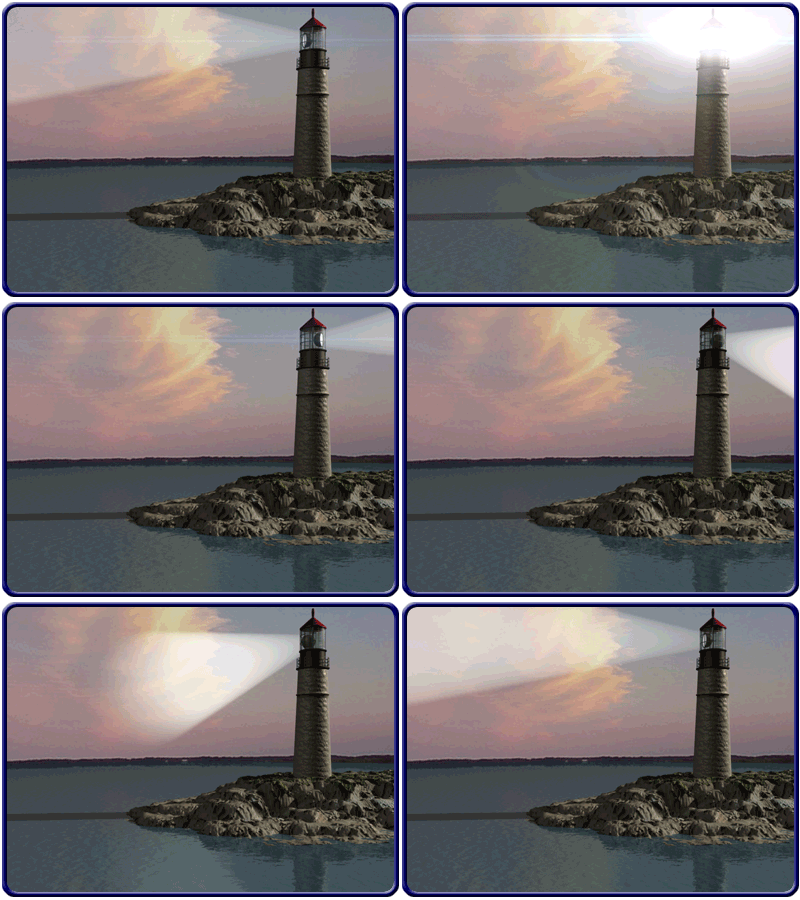
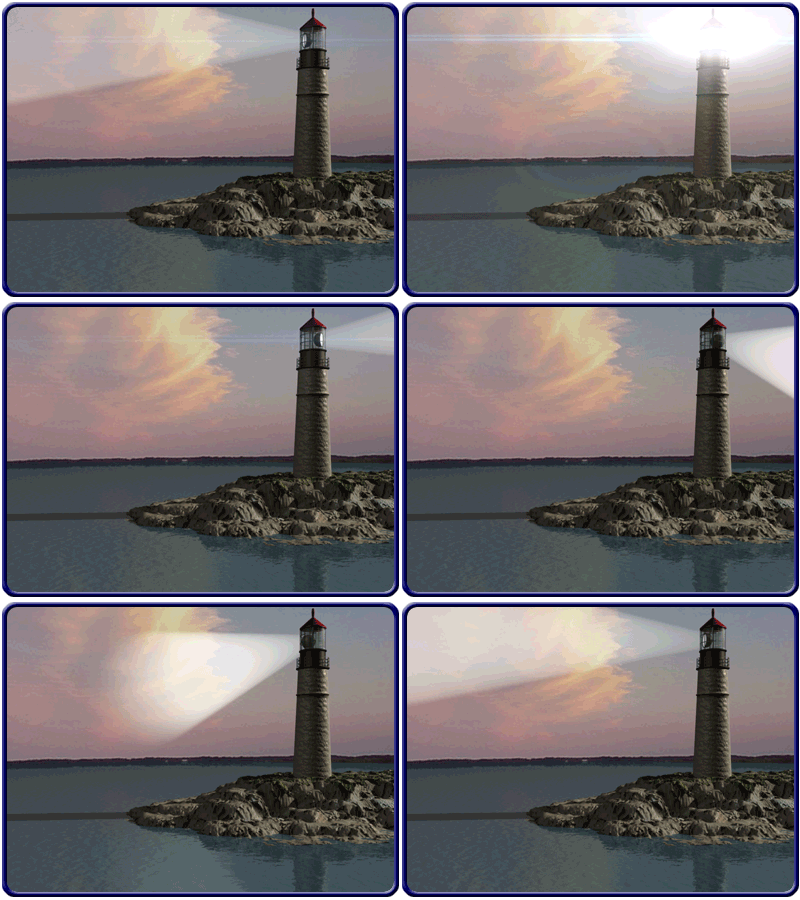
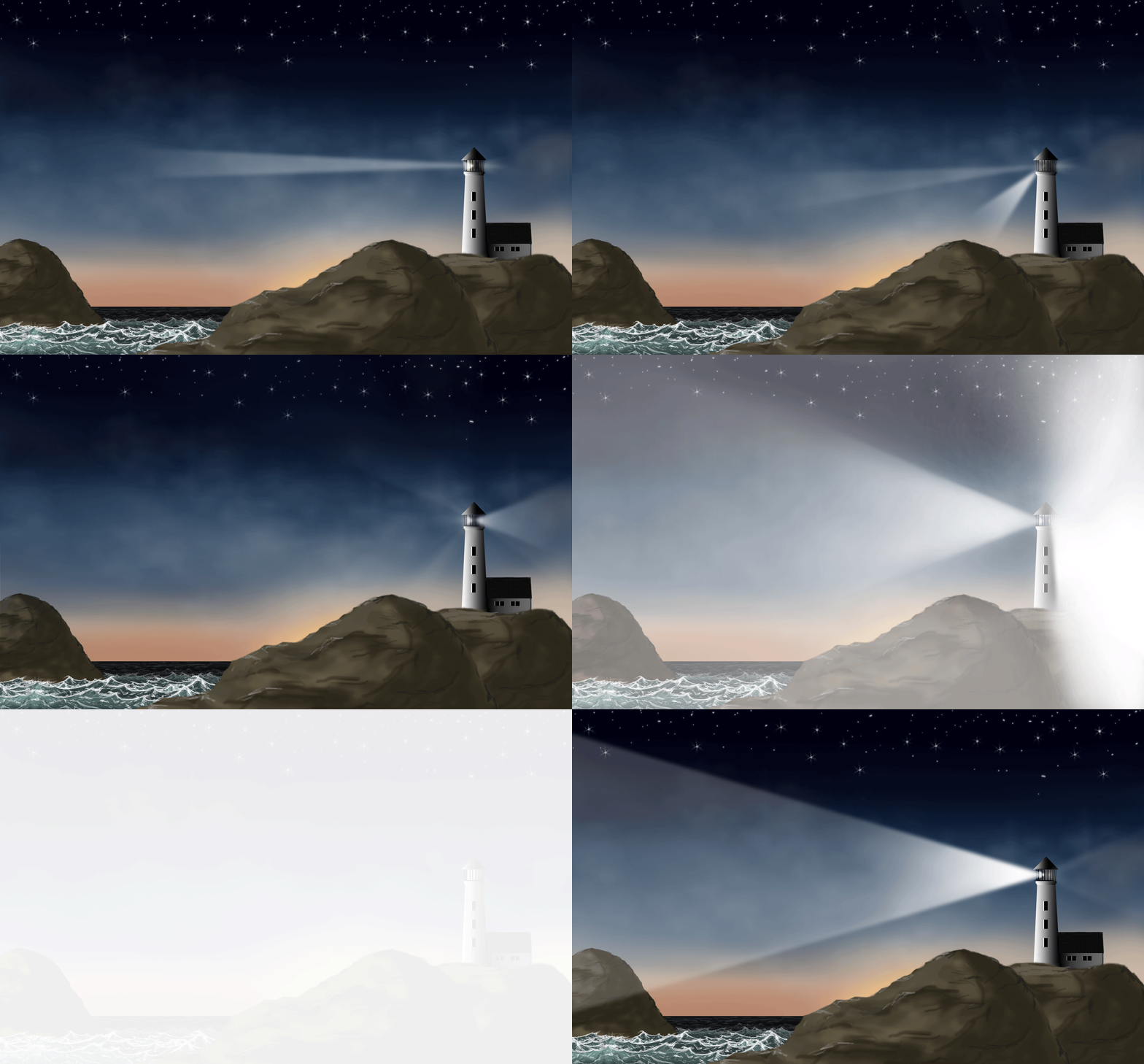
Before modern strobe lights, lenses were used to concentrate the light from a continuous source. Vertical light rays of the lamp are redirected into a horizontal plane, and horizontally the light is focused into one or a few directions at a time, with the light beam swept around. As a result, in addition to seeing the side of the light beam, the light is directly visible from greater distances, and with an identifying light characteristic.
This concentration of light is accomplished with a rotating lens assembly. In early lighthouses, the light source was a kerosene lamp or, earlier, an animal or vegetable oil Argand lamp, and the lenses rotated by a weight driven clockwork assembly wound by lighthouse keepers, sometimes as often as every two hours. The lens assembly sometimes floated in liquid mercury to reduce friction. In more modern lighthouses, electric lights and motor drives were used, generally powered by diesel electric generators. These also supplied electricity for the lighthouse keepers.
Efficiently concentrating the light from a large omnidirectional light source requires a very large diameter lens. This would require a very thick and heavy lens if a conventional lens were used. The Fresnel lens (pronounced focused 85% of a lamp's light versus the 20% focused with the parabolic reflectors of the time. Its design enabled construction of lenses of large size and short focal length without the weight and volume of material in conventional lens designs.
Fresnel lighthouse lenses are ranked by order, a measure of refracting power, with a first order lens being the largest, most powerful and expensive; and a sixth order lens being the smallest. The order is based on the focal length of the lens. A first order lens has the longest focal length, with the sixth being the shortest. Coastal lighthouses generally use first, second, or third order lenses, while harbor lights and beacons use fourth, fifth, or sixth order lenses.
Some lighthouses, such as those at Cape Race, Newfoundland, and Makapuu Point, Hawaii, used a more powerfulhyperradiant Fresnel lens manufactured by the firm of Chance Brothers.
In recent times, many Fresnel lenses have been replaced by rotating aerobeacons which require less maintenance. In modern automated lighthouses, this system of rotating lenses is often replaced by a high intensity light that emits brief omnidirectional flashes (concentrating the light in time rather than direction). These lights are similar to obstruction lights used to warn aircraft of tall structures. Recent innovations are "Vega Lights", and initial experiments with light-emitting diode(LED) panels.
In any of these designs an observer, rather than seeing a continuous weak light, sees a brighter light during short time intervals. These instants of bright light are arranged to create a light characteristic or, pattern specific to a lighthouse. For example, the Scheveningen Lighthouse flashes are alternately 2.5 and 7.5 seconds. Some lights have sectors of a particular color (usually formed by colored panes in the lantern) to distinguish safe water areas from dangerous shoals. Modern lighthouses often have unique reflectors or Racon transponders so the radar signature of the light is also unique.
Design-
For effectiveness, the lamp must be high enough to be seen before the danger is reached by a mariner. The minimum height is calculated by trigonometric formula where H is the height above water in feet, and d is the distance to the horizon in nautical miles.
Where dangerous shoals are located far off a flat sandy beach, the prototypical tall masonry coastal lighthouse is constructed to assist the navigator making a landfall after an ocean crossing. Often these are cylindrical to reduce the effect of wind on a tall structure, such as Cape May Light. Smaller versions of this design are often used as harbor lights to mark the entrance into a harbor, such as New London Harbor Light.
As technology advanced, prefabricated skeletal iron or steel structures tended to be used for lighthouses constructed in the 20th century. These often have a narrow cylindrical core surrounded by an open lattice work bracing, such as Finns Point Range Light.
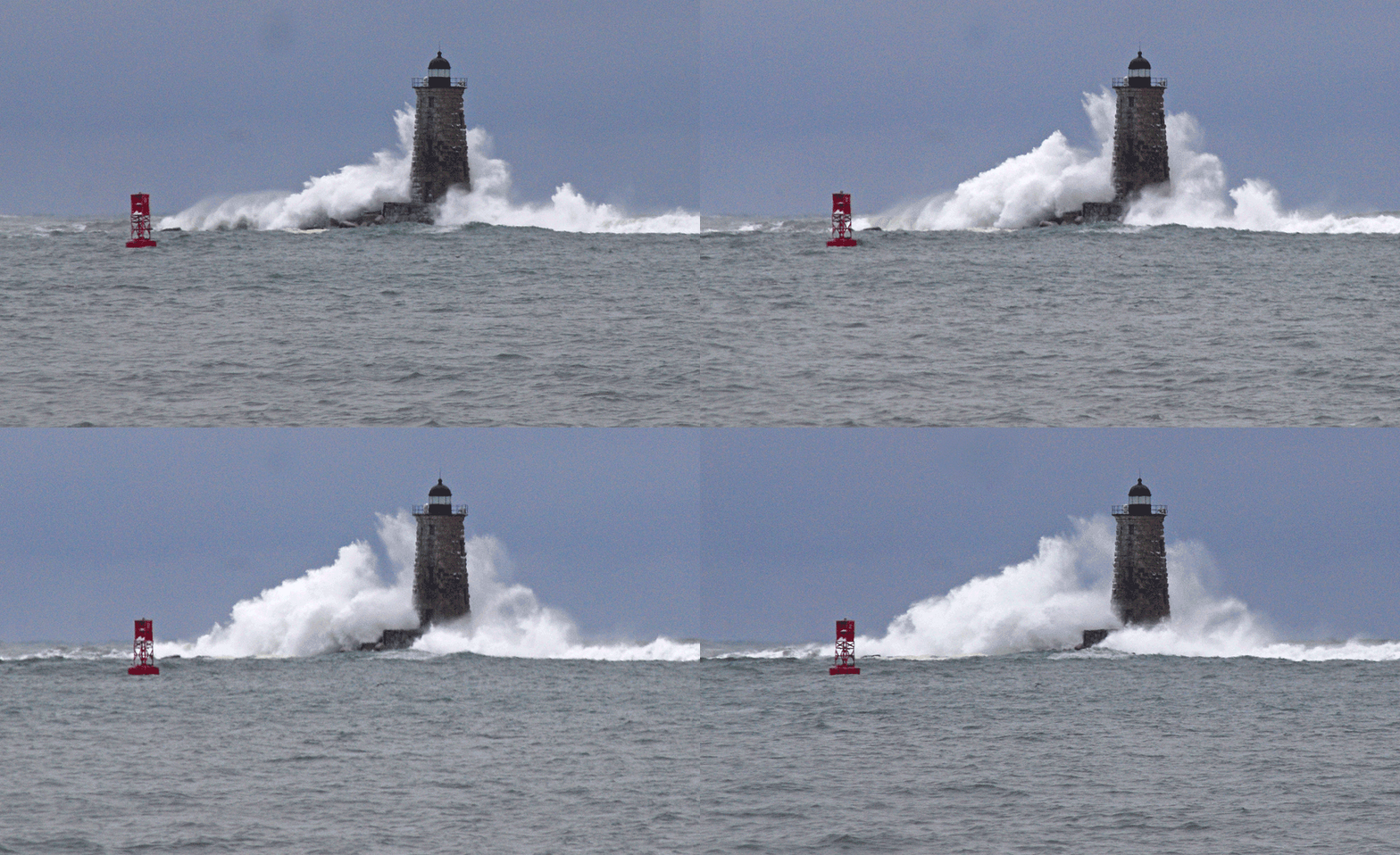
Sometimes a lighthouse needs to be constructed in the water itself. Wave-washed lighthouses are masonry structures constructed to withstand water impact, such asEddystone Lighthouse in Britain and the St. George Reef Light off California. In shallower bays, Screw-pile lighthouse ironwork structures are screwed into the seabed and a low wooden structure is placed above the open framework, such asThomas Point Shoal Lighthouse. As screw piles can be disrupted by ice, steel caisson lighthouses such as Orient Point Lightare used in cold climates. Orient Long Beach Bar Light (Bug Light) is a blend of a screw pile light that was converted to a caisson light because of the threat of ice damage.
In waters too deep for a conventional structure, a lightship might be used instead of a lighthouse, such as the formerlightship Columbia. Most of these have now been replaced by fixed light platforms (such as Ambrose Light) similar to those used for offshore oil exploration.
The lantern room is the glassed-in housing at the top of a lighthouse tower containing the lamp and lens. Its glass storm panes are supported by metal Astragalbars running vertically or diagonally. At the top of the lantern room is a stormproof ventilator designed to remove the smoke of the lamps and the heat that builds in the glass enclosure. A lightning rod and grounding system connected to the metal cupola roof provides a safe conduit for any lightning strikes.
Immediately beneath the lantern room is usually a Watch Room or Service Room where fuel and other supplies were kept and where the keeper prepared the lanterns for the night and often stood watch. The clockworks (for rotating the lenses) were also located there. On a lighthouse tower, an open platform called the gallery is often located outside the watch room (called the Main Gallery) or Lantern Room (Lantern Gallery). This was mainly used for cleaning the outside of the windows of the Lantern Room.
Lighthouses near to each other that are similar in shape are often painted in a unique pattern so they can easily be recognized during daylight, a marking known as a daymark. The black and white barber pole spiral pattern of Cape Hatteras Lighthouse is one example. Race Rocks Light in western Canada is painted in horizontal black and white bands to stand out against the horizon.
Range lights-
Aligning two fixed points on land provides a navigator with a line of position called a range in the U.S. and a transit in Britain. Ranges can be used to precisely align a vessel within a narrow channel such as in a river. With landmarks of a range illuminated with a set of fixed lighthouses, nighttime navigation is possible.
Such paired lighthouses are called range lights in the U.S. and leading lights in the United Kingdom. The closer light is referred to as the beacon or front range; the furthest away is called the rear range. The rear range light is almost always taller than the front.
When the vessel is on the correct course, the two lights line up vertically. But when the observer is out of position, the difference in alignment indicates the proper direction of travel to correct the course.
Popular culture & symbolism-
Visiting and photographing lighthouses are popular hobbies as is collecting ceramic replicas. Some lighthouses are popular travel destinations in their own right, and the buildings maintained as tourist attractions. In the U.S., National Lighthouse and Lightship Weekend is celebrated on the first weekend of August, and International Lighthouse and Lightship Weekend on the third weekend. Many lighthouses are open to the public and amateur radio operators communicate between them on these days.
To recognize the role of lighthouse keepers in maritime safety, the U.S. Coast Guard named a class of 175-foot (53 m) coastal buoy tenders after famous U.S. lighthouse keepers. Fourteen ships in the class were built between 1996 and 2000.
A widely disseminated urban legend tells of a radio conversation between a U.S. or British naval vessel and what is believed to be another ship on a collision course. The naval vessel insists the other ship change course, but the other ship continues to insist the naval vessel do so. After the captain of the naval vessel identifies himself and demands a course change, the other party responds with, "I'm a lighthouse. It's your call".
The Disney film Pete's Dragon featured a lighthouse and the resulting Helen Reddy song Candle on the Water alludes to it. The Australian television series Round the Twist also involved a family living at Split Point Lighthouse. The long-running American soap opera Guiding Light has featured a lighthouse in many of its opening title segments, and the fictional Springfield, Illinois has a lighthouse situated near the town.
The Adventures of Portland Bill was a British stop motion animated children's television series made in 1983. Set in a fictional lighthouse, the name of its main character was a reference to the Portland Bill Lighthouse in Dorset. Many of the other characters were plays on the names of coastal regions, made familiar to the wider public by the BBC Radio 4 Shipping Forecast.
